

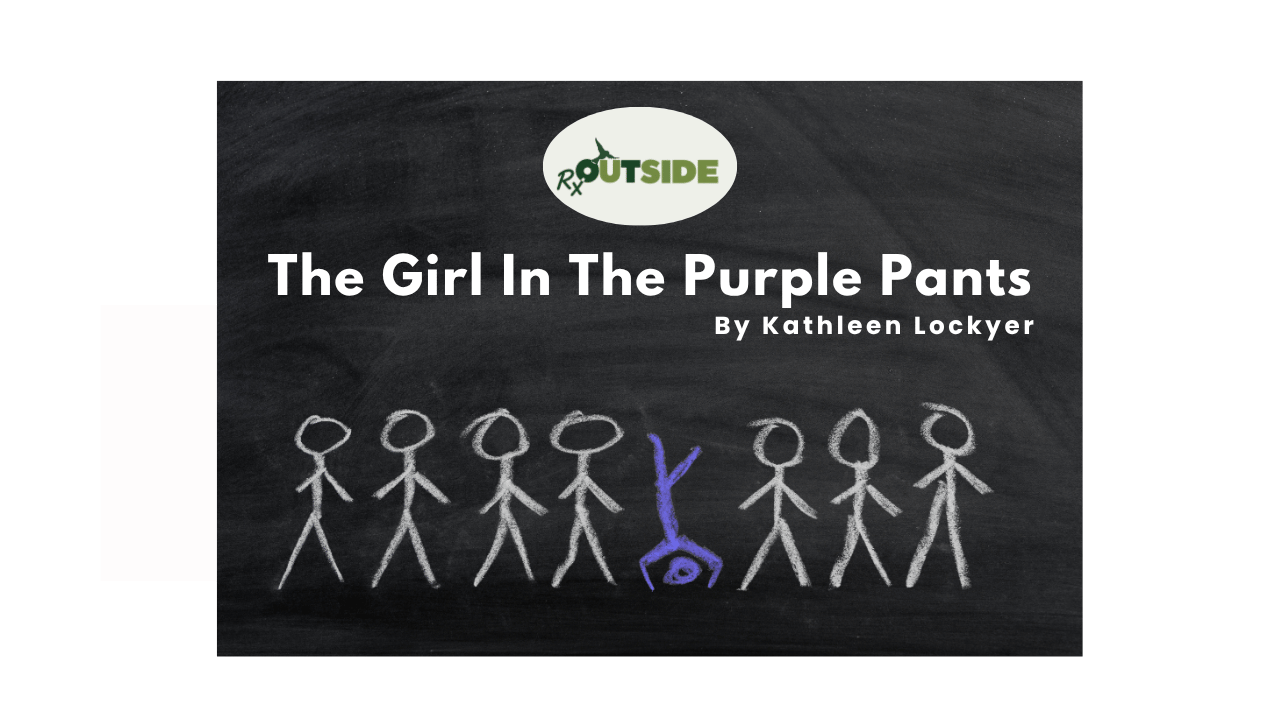
The Girl In The Purple Pants
When I was in junior high school, all the girls were feathering their hair and wearing new Jordache Jeans — they had "the Jordache Look! "

I, on the other hand, still wore my trusty purple corduroy pants every day and let my mom butcher my hair.
The corduroy was worn-in and soft to the touch. Not too tight or too loose. My pants weren’t scratchy or pinchy anywhere, and I could run, ice skate, and jump rope the way I’d always done.
I hadn’t thought about those pants for a long time until recently, when I was talking with a longtime friend and colleague. He asked me how my upcoming course registration was going, and I made a comment about not being very good at marketing, to which he laughed and said,
“I don’t think it’s that you’re not good at it. I think you’re like me and we don’t really care about those things.”
I had to think about whether that was true.
And as I did, I found myself thinking about those purple pants.
One day after class, I closed up my workbook, stacked my books and carried them into the hallway where a group of those feather-haired, Jordache wearing girls moved to the side in unison as I walked by.
“Hey! So why do you wear those same purple pants every day?”
I looked down. I hadn’t ever thought about it.
I mean, why would would I. They were my favorite color, and they were comfortable.
I looked back up, staring at their bright blue liquid eyeliner. I drew my gaze down to their crisp, very pinchy-looking jeans.
And for the first time, I noticed. There was me and my purple pants...
and there was a whole lotta other girls in jeans. Jordache Jeans. They had the look.
The funny thing is, before that moment I hadn’t noticed and I hadn’t cared. But I did notice plenty of other things.
I noticed the way a peer’s eyes squinted when they looked at the board, or who bounced their knee up and down under the desk.
I noticed who sat alone at lunch and who was surrounded by other kids.
I noticed when a teacher singled out the same kid again and again for not having their homework done.
And I knew exactly what time a certain group of kids blocked the bridge between the side of the school and the easiest sidewalk home. I also knew there was a route that was usually empty of threatening teenagers even though it was a longer walk home.
So it wasn’t a general lack of noticing. I noticed plenty.
My brain just prioritized some information while it put other information in the background. The word for this is salience and it’s incredibly important we understand it in our work with children.
Our brains are surrounded by far more sensory and environmental information than we could possibly pay conscious attention to at once.
So the brain has to prioritize, identifying some things as important enough to capture our attention while allowing other things to fade into the background.
Much of that prioritizing happens outside of our conscious awareness.
And what becomes salient for one person, won’t be salient for someone else.
Each nervous system is influenced by things like sensory sensitivities, personal characteristics, previous experiences, current needs, emotional significance, expectations, and whether something might matter for our safety.
Which means two people can be doing the exact same thing, in the exact same environment and, neurologically speaking, be having very different experiences of it.
Those girls noticed my pants while I noticed the kids blocking the bridge.
We were all attending the same school and yet were having very different experiences.
And this is why I think salience becomes incredibly important for those of us working with children. Because what we notice about an environment isn’t necessarily what they notice.
And what seems important to us may not be what their nervous system has decided is important at all.
Adults might say:
“He’s not paying attention.”
Instead we could ask, What is he paying attention to?
“She overreacted for no reason.”
Instead we could wonder what in that moment became salient to her nervous system that wasn’t salient to ours?
“He knows what he’s supposed to do.”
Maybe.
But in that moment, was our instruction actually the most compelling information available to his brain?
Or was there another salient detail his brain was tuning into?
This is one of the reasons I am so interested in behavior that doesn’t immediately make sense.
For example, in chapter nine of Wild Inside I discuss a young boy, Jose, who according to his preschool teachers would have outbursts out of nowhere.
“One minute he’s fine; the next he’s screaming, throwing toys, hiding behind the bookshelf. I’ve tried everything. He just won’t listen.”
When I spent a little time with Jose, I discovered that his nervous system had been tuned to a specific kind of environmental stimuli that was constantly registering as sensory insults and once his bucket of tolerance was full, the last drop overflowed into a full-on meltdown. But it was a cumulative effect, not out of nowhere.
So before we try to change what captures a child’s attention, we need to understand what has it in the first place.
What has this child’s nervous system decided is important to notice?
And why?
That’s what I notice, and also what I truly care about.
And I suspect it’s also why many of you found your way to my work.
Maybe you were the kid in the purple pants.
Maybe you’ve always noticed things other people don’t.
Or maybe you’ve sat in a meeting listening to everyone agree about changing a child's behavior while a little voice inside you keeps saying:
Yeah, but don't we want to know why he is having this behavior?
I urge you to pay attention to that voice and stay curious about it.
Keep noticing, questioning, testing, observing and revising your understanding, because children give us far more information than many people notice.
Yet somewhere along the way, many of us learned the professional equivalent of buying the Jordache Jeans.
To get the degree, we had to learn to wear uncomfortable pants for a while.
We learned the accepted language, the standard interventions and the typical explanations. We got the look.
And while it is essential that we understand the scope of our practice, it’s also essential we reclaim the unique ways we wonder about the world and our clients.
Because perhaps in becoming the professionals we thought we were supposed to be, our own salience networks became tuned to notice the expected things.
And maybe some of our curiosity about differently wired clients living in a standardized world became dulled.
It is our willingness to wonder differently about what a child’s unique ways are asking us to notice, and our courage to honor the kids in the purple pants instead of telling their parents to buy the Jordache Jeans, that makes us an irreplaceable voice in our clients’ lives.
That is a big part of why I created the NatureLed™ Framework.
The Framework puts behavior in context and considers the nervous system, the senses, movement, relationships, environment, developmental experience, prediction, play and nature as one operating system rather than separating a human being into a collection of problems that need fixing.
And the Applied NatureLed™ Mentorship is where we learn to put that way of seeing into practice.
The mentorship isn’t another collection of nature activities to add to your therapy toolbox, and it isn’t a business course.
It’s an intimate experience for practitioners who want to deepen their clinical reasoning, integrate the core routines of nature connection into the work they’re already doing, and become confident engaging with nature as a co-therapist rather than as a backdrop for therapy.
In other words, it’s about learning to confidently wear your purple pants in a room full of Jordache Jeans.
I’ve spent 30 professional years caring about the importance of differences and I care deeply about making it easier for you to do this work without having to get an advanced degree from the School of Hard Knocks like I did.
I want you to trust what you notice while having the science, structure and clinical reasoning to know what to do with it.
Because ultimately, I care about the next generations belonging to nature so they can grow, heal and believe in a future worth engaging with.
P.S. I still care about comfort over fashion.
And although I dream about being that stylish woman with a signature look that is unmistakably hers, I really still like wearing the same comfortable pair of pants every day.
The difference is that now, when I find a pair I really like, I buy two and rotate them.
If I’m feeling a bit wild, I buy them in two different colors.
Stay connected with news and updates!
Join our mailing list to receive the latest news and updates from our team.
Don't worry, your information will not be shared.
We hate SPAM. We will never sell your information, for any reason.



Author


