Every child belongs
outside
Not every child arrives ready.
Training for mentors who want tools to support more learners.
Workshops for Nature Connection Mentors
A story from the field.
She'd been leading sit-spot for six years.
She'd been leading sit-spot for six years.
She was good at it — the kind of mentor who could coax a heron call out of a shy twelve-year-old, who knew which questions to ask, and when. She loved her work.
Then she noticed a change.
More of the kids were arriving with different needs. A bit more overwhelmed. Vigilant. Less focused. Less curious. A boy who shut down and checked out when the group transitioned. A girl who ran when the fire circle got loud. Parents who said things at drop-off like: "He does better in nature than anywhere else. Please just give him a chance."
She was still the same mentor. Her instincts were still good. But for the first time, her naturalist skills and care for the kids weren't enough — and she didn't know why, or what to do about it.
This workshop is for her.
There has been a big shift in
the kids coming through
your programs.
You've felt it. It looks like:
- More kids who struggle with transitions
Moving from one activity to the next used to be simple. Now it can unravel a whole morning. You haven't changed your program design but more nervous systems genuinely can't make that shift without support you didn't know they needed.
- More kids who can't play hide-and-seek games
Eagle eye and deer and fawn used to be easy go to games on your program. For some kids they still ar. But you're also seeing children who physically cannot stay in one place, who disrupt the whole group, who seem unreachable — and you're not sure if it's behavior or something else entirely.
- More kids whose parent's say "They do better outside."
You're becoming known as the place where kids who don't fit anywhere else actually thrive. That's a beautiful thing. It's also a responsibility — because "being accepting" and "having the tools to actually support" are two very different things.
- More kids who seem younger than their age
Children arriving with fewer baseline skills than the same age group used to have. Less risk tolerance. Less capacity for frustration. Less independence outdoors. Your mentoring strategies were built for kids who arrived with a certain developmental foundation — and more of them aren't arriving with it.

You became a nature connection mentor because you believe nature heals. You're right. But sometimes your students need a bridge —
and that bridge is you.

Your mentors are skilled naturalists
They are amazing nature-craftertons. They know the land, the plants, the fire, the ecology. What they also need — is an understanding of the human nervous system.
Why a child bolts. What "shutdown" looks like and how it's completely different from defiance, even though they look identical from the outside. Why the same invitation that opens one child up, completely shuts another one down.
Neurodiversity isn't new. But the number of neurodiverse children in nature connection programs has grown significantly — and so has the number of children carrying developmental gaps from environments that didn't give their nervous systems what they needed early on.
These children are often extraordinary in a forest setting. But they need something different from your mentors than your traditional approaches provide — and right now, your mentors are improvising. Doing their best. Sometimes getting it right by instinct, sometimes accidentally making things worse without knowing it.
That's a gap in training. And it's exactly what this workshop offers to level up your program.
Words from our friends
Participant of Neurodiversity For Nature Connection Mentors Workshop
Our team came away from our training with Kathleen feeling so much more prepared for our summer season, when we often encounter students who don’t fit the neuro-expected mold. She provided skills, practical advice, and theory that all painted a very comprehensive picture of how best to support students in a moment of need. All of the information was also presented through a lens of nature connection and 8 Shieds work, which greatly helped our staff feel able to integrate the tools easily into our programs. We really look forward to working with Kathleen more in the future, as she is clearly a wealth of knowledge and wisdom with a lot to offer our community!
KerensaForest Floor Program Director
Participant of the NatureLed Approach Certification Course
"Thanks to this course, I can do what I do, better. Through the NatureLed™ Approach Certification program I am now able to design my programs with greater confidence, deliver a more effective and transformative experience for the young people I serve, as well as communicate my methods more readily to parents, teachers, therapists, and the public.
The NatureLed™ Approach has helped me develop an understanding of the science and showed me how to apply it in a way accessible to myself, my staff, parents, and the public."
Christopher Green, Co-Owner of the Guelph Outdoor School, Ontario, Canada
If any of this sounds familiar,
you're in the right place .
✔ A child in your program has been labelled "a handful" — but you sense there's something more going on that you don't have the language for.
✔ Your mentors are experienced naturalists but have little or no background in child development, sensory processing, or trauma-informed practice.
✔ You've started quietly dreading certain enrollments — you really want those kids, but you don't know how to support them well.
✔ Parents of neurodiverse children seek you out specifically. You want to honor that trust — but you know your team isn't fully equipped..
✔ A mentor came to you after a hard day and said "I don't know what I'm doing wrong" — and you didn't know what to tell them.
✔ The strategies that worked beautifully five years ago aren't having the same affect with today's groups.
✔ You believe with everything in you that nature is the right environment for all children. You just need your team to know how to work with more differences.
✔ You want to be the program that doesn't just accept neurodiverse kids — but genuinely serves them well.
Every Child Belongs Outside:
Supporting Neurodiversity in Nature Connection Programs.
A 3-hour, research-backed, practically grounded training built specifically for nature connection mentors — not classroom teachers, not therapists, not camp counselors.
This is the training that meets your team where they are: people who love children and love the natural world, who want to understand why certain kids respond the way they do — and what they can actually do about it in the field, with the tools already in their hands.
We're not asking your mentors to become occupational therapists. We're asking them to understand one framework well enough to see every child differently — and to walk away with a handful of strategies they'll use the very next day they're out.
What we cover in three hours
Structured to build knowledge and skills. Practical from the first twenty minutes.
Hour One
The Nervous System
Before a child can connect with a raven call or a sit spot, their nervous system has to feel safe enough to let them. This hour gives mentors a framework to understand why — and to see behavior through an entirely different lens.
→ What neurodiversity actually means for your program
→ The three nervous system states, in plain language
→ Why behavior is communication, not defiance or attention getting
→ How sensory differences show up outdoors
→ The language shift from "neurotypical" to "neuro-expected"
Hour Two
The Goldilocks Zone — Your Universal Framework
Not too easy, not too hard. The brain has a learning sweet spot — and the living landscape finds it naturally, if your mentors know how to read the signs and protect the conditions.
→ The neuroscience of the just-right challenge
→ Reading the three zones in real time
→ What to do when a child is in each zone
→ Why nature is both calming and alerting
→ Outdoor practice: creating a container for Zone 2
Hour Three
Your Toolkit: From theory to practice
Five tools your mentors will actually use. Practical, low-cost, and designed for the field — not a classroom. Every strategy is connected to the framework so mentors understand not just what to do, but why it works.
→ Front-loading: the single highest-leverage thing a mentor can do
→ The Break Spot: introduce it on day one, for everyone
→ Heavy work as a regulation tool in nature
→ The Contingency Map for high-risk activities
→ Adaptations for fire, whittling, sit spot, field games
Your mentors leave with:
⏺ A framework that makes every child easier to read
⏺ Five field-ready tools they can use the next day.
⏺ The NatureLed™ Toolkit — full reference document for the field.
⏺ A full color, downloadable Goldilocks Quick Read card that can be printed and laminated for every mentor's pack.
⏺ Language to talk to parents about what you're doing and why
⏺ A reframe of staff roles that makes hard days feel purposeful.
This workshop is for you if...
✔ You lead a nature connection program
Forest school, wilderness camp, nature-based mentoring, sit spot programs, rewilding work — if your mentors are outside with children regularly, this training applies directly.
✔ You're mentors are naturalists first
Deeply skilled with place, tracking, fire, plant knowledge — but without formal training in child development, sensory processing, or behavior support. This training respects what they know and builds on it.
✔ You're seeing more diverse needs in your groups
More kids with autism, ADHD, sensory sensitivities, trauma histories, behavior challenges or developmental gaps. More parents who chose you specifically because their child struggles everywhere else.
✔ You want practical tools designed specifically for nature connection programs.
This is not designed for working with behavior in traditional settings. It's for programs that are focused on connecting with nature, or survival skills programs. Mentors will learn how to apply techniques that are relevant and leave with tools they understand deeply enough to actually use.
✔ This workshop is not for you if...
You're looking for a one-size-fits-all behavior management system, or a way to make neurodiverse kids conform to your existing program structure. This training is built on a different premise entirely: the children who challenge your program most are often the ones who need it most — and your role is to understand them well enough to let nature do what it is best at doing.
Your mentors are already doing something remarkable
This workshop gives them the one layer they're missing — so the children who need nature the most don't just find a beautiful place, but a team that actually knows how to meet them there.
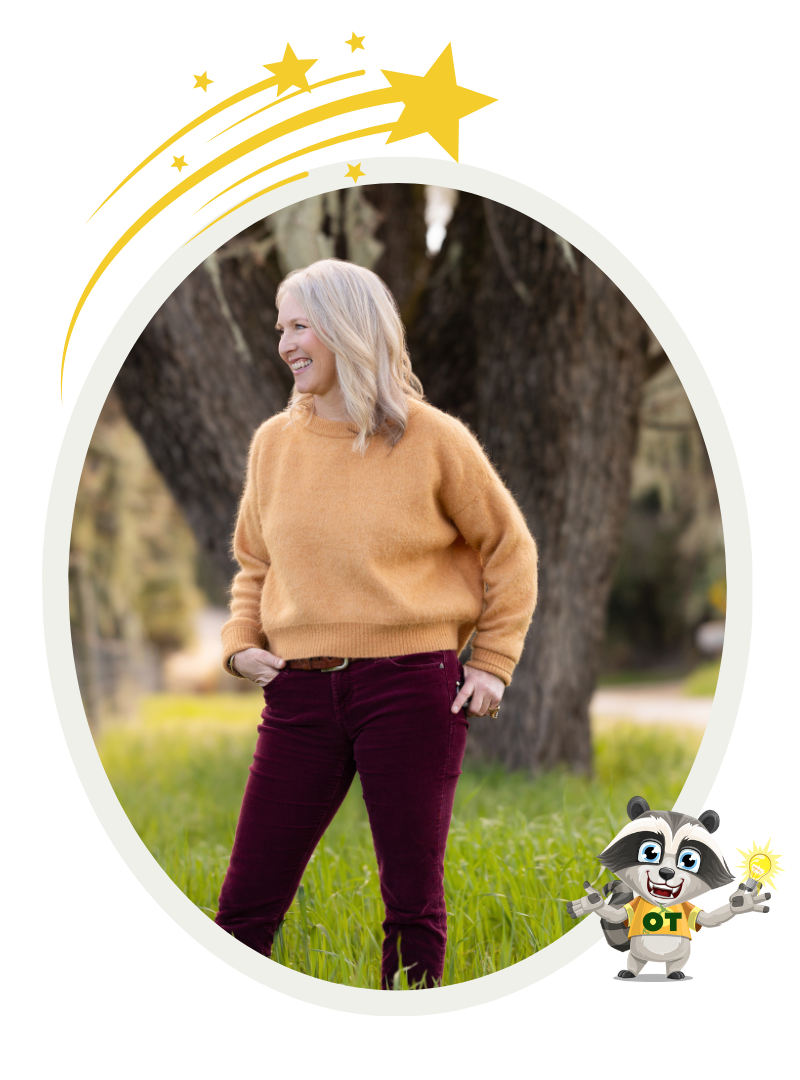
I’m Kathleen Lockyer
Occupational Therapist and Creator of the NatureLed™ Approach
Thirty years ago, before nature-based practice was a thing, Kathleen Lockyer wrote her senior thesis on the loss of biodiversity and its impact on human health. She began her career already asking the question: What habilitates humans and how does nature play a role?
Her vision was shaped by her father, who took her outside without agendas, by the teachings of Jon Young and Rosemary Gladstar, by a lineage of practitioners and thinkers who understood that the relationship between humans and the living world is not a tool or an optional recreational pursuit, but rather a biological imperative. It is, in the truest sense of the word, our most meaningful “occupation.”
She once asked her father what he had done to make her so “nature-connected.” He said: "I didn't do anything. You just came that way."
Kathleen believes we all come that way. Most of us simply weren't given the permission — or the guidance — to stay connected.
That belief is the foundation of everything she has built.
Practitioners who learn with Kathleen tend to say the same thing: that her warmth and realness make the hard stuff land without the weight, that her sessions feel like something deep within that they are remembering, and that for the first time in a long time, learning feels like coming home.
She has nearly 30 years of experience at the intersection of nature and OT. But that isn’t why people come to learn with her.
They come because Kathleen has a way of walking them to the trailhead and helping them step onto a path they have longed for — the way a really good grandmother opens the door and welcomes you in.
We recognize the yak titʸu titʸu yak tiłhini (Chumash) peoples as custodians of the lands where RxOUTSIDE resides, widely known as Atascadero and Morro Bay, California. We are grateful to their elders, past and present, and recognize their enduring connection to this land.
There is no statement we could make here to right the terrible ways people have behaved toward one another and the natural world over our shared history. RxOutside is committed to reflection of how we have been complacent or ignorant to the experience of oppression and invite ongoing conversation about healing our humanity ([email protected])
In gratitude and with respect we honor the wisdom keepers of the Haudenosaunee Nation whose land Kathleen grew up on, for offering to the human family the "words before all else — The Thanksgiving Address" which honors "all our relations," and to Jake Swamp (Tekaroniankeken), traditional Mohawk spiritual leader, and his wife Judy (Kanerataronkwas) for sharing it with so many. It has profoundly supported Kathleen's life — And we offer gratitude and respect to The people, the earth, the stones, the waters, the mosses-mycelium-fungi, the insects-reptiles-amphibians, the low-lying plants, the four leggeds, the trees, the birds, the winds, the directions, the sun, the moon, the stars, the wisdom keepers, the ancestors, anything not mentioned and the spirit that moves through all things and connects us as one.
Kathleen honors her ancestors from Western Ireland, County Cork, and Northern Italy, recognizing their resilience and the rich cultural legacy of those cultures — both the skillful and the unskillful. Their spirit, deeply rooted in her ancestral lands, shapes her identity and continues through generations.
Video of 'The Words Before All Else'Contact us to get your workshop scheduled.
Bring an AOTA CEU approved workshop to your staff.
Workshops for public and private organizations.
Fill in your contact information below.


