Decorative illustration of a dandelion

FREE WEBINAR FOR NATURE CURIOUS THERAPISTS


What If One Small Shift Could Help You Improve Client Outcomes?

Transform your practice.

and love your work again.
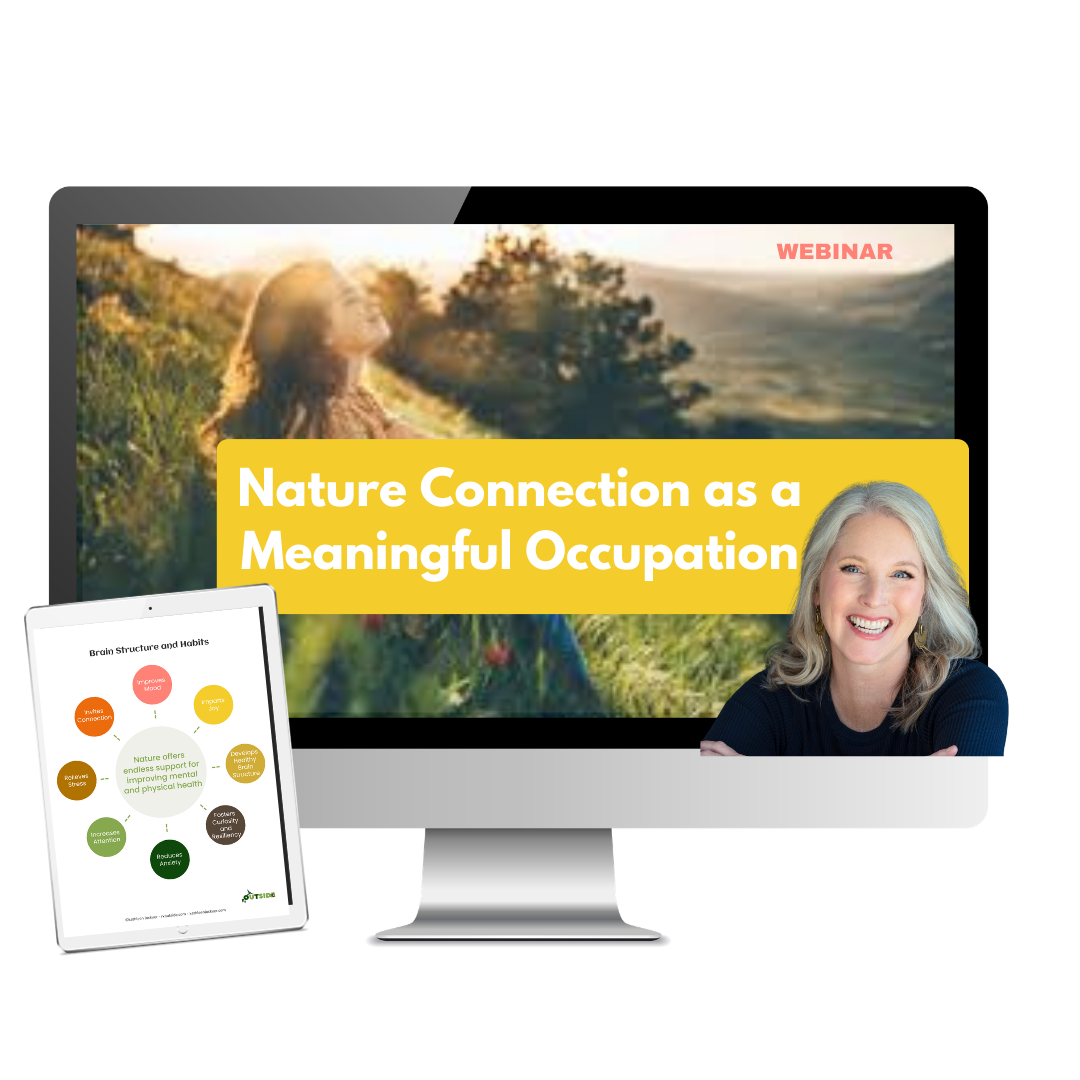
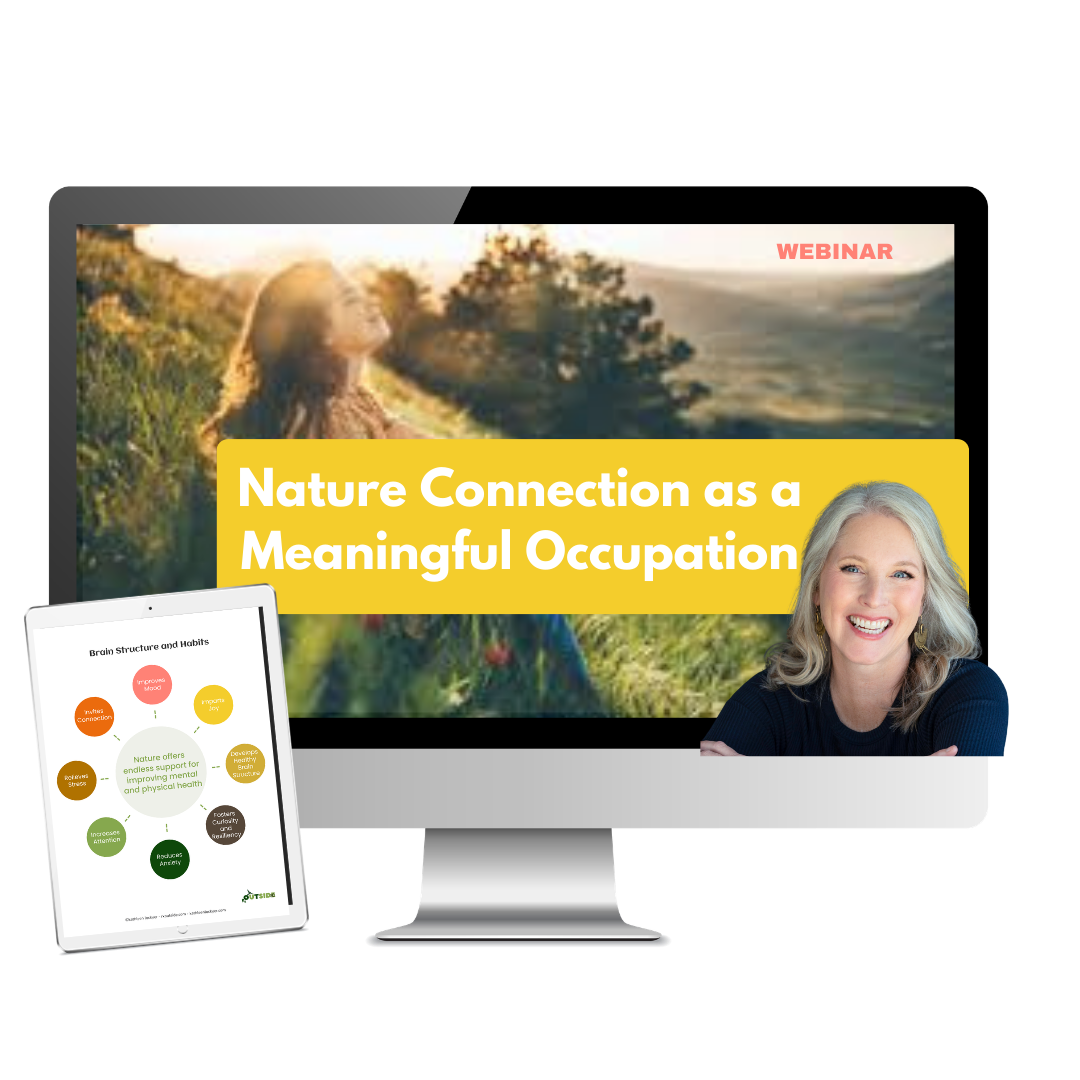
A digital toolkit display featuring worksheets, a laptop with a butterfly image, a tablet, and a smartphone showing a smiling Kathleen— showing the course contents.
ACCESS THE VIDEO

Join us for this free introductory session and see why the "Next Generation of OT" is heading outdoors.
.

A sprig of olive tree with slender stems and elongated leaves.

In this course, you’ll explore a new clinical lens emerging at the intersection of occupational science, developmental neuroscience, and environmental psychology.

WHAT YOU'LL LEARN: EXPANDING THE CLINICAL LENS

1

Nature as a primary activity of daily living: Occupation.


An analysis of why nature-connection may be categorized as a primary human occupation rather than merely a therapeutic setting.

Nature-Based → Nature-Connective 

You will recognize the limitations of treating the environment as a "backdrop" and discover how to frame nature-connective engagement as a billable, goal-directed occupation within the OTPF-4.

2

The mechanism of the “occupational void." 


A description of the "Occupational Void"—the metabolic and sensory deficit created when the nervous system is deprived of ancestral affordances.

You will identify the hidden environmental barriers that contribute to clinical plateaus and understand why traditional sensory diets may not fully address the "Species-Atypical" stress of the modern clinic.

3

Habilitation versus Rehabilitation. A clinical distinction.


An exploration of the distinction between rehabilitating lost skills and habilitating foundational capacities that were never established.

You will analyze why targeting "top-down" executive function often fails when the "bottom-up" biological foundation is missing, shifting your perspective on how to achieve true functional generalization.
Learning Objectives

  • Define nature-connection as a foundational human occupation within the OTPF-4 and its relevance across occupational domains.

  • Analyze the neurological distinction between Habilitation and Rehabilitation, and describe why "bottom-up" biological foundations are necessary for "top-down" functional generalization.

  • Differentiate between nature-based and nature-connective approaches and identify at least two opportunities to incorporate nature-connective contexts into occupational therapy practice.

A digital toolkit display featuring worksheets, a laptop with a butterfly image, a tablet, and a smartphone showing a smiling Kathleen— showing the course contents.

If you are searching for ways to reduce stress and restore meaning to your work, while motivating your clients to reach their goals, this conversation will expand how you think about intervention.

Nature Connection as a Motivating Daily Activity

Access the FREE training!
Illustration of a bee flying with a dotted path trailing behind it on a light background, evoking nature connection and the joy of happy children exploring the outdoors.

Hi! 

I'm Kathleen Lockyer

Occupational Therapist | Parent, Author | Founder of the NatureLed™ Approach


I see you.
The passionate helper who is frustrated by the cage that is modern intervention.

For 30 years, I’ve watched the 'Clinic Box' grow smaller while our clients' needs grow more complex. Therapists are trying to solve deep-seated challenges in praxis, motor planning, and social participation with synthetic tools inside four sterile walls—ignoring a fundamental clinical fact: humans evolved outside.

Your frustration is a natural response to the 'Occupational Void'—the lack of species-typical environmental input—it is a poorly understood reason why our clients plateau and why so many dedicated practitioners burn out.

As the founder of the NatureLed™ Approach, I’ve spent three decades bridging evolutionary biology with occupational science. I don't teach you to take therapy outside. I teach the hard science of how environmental context dictates the mastery of occupation. I show you how to reclaim our clinical power and facilitate true functional participation by returning to the interactive experiences the human species was designed to navigate.

I provide a neurobiological roadmap for OTs who are ready to break down the modern environmental barriers — so they can implement effective and efficient interventions and LOVE their work. If you are still reading, you have found your people! Don't let the clinic cage prevent you from being the therapist you know you can be.

Kathleen with long gray hair smiles at the camera, wearing a mustard yellow sweater and a necklace, with abstract graphic lines and leaves in the background, reflecting her deep connection to nature education.
a wide banner acroiss the page with an illustration of long grass and a fluttering orange and black butterfly.
Green and white RXOutside logo

Terms

Privacy Policy

Financial Policy

Disclaimers